
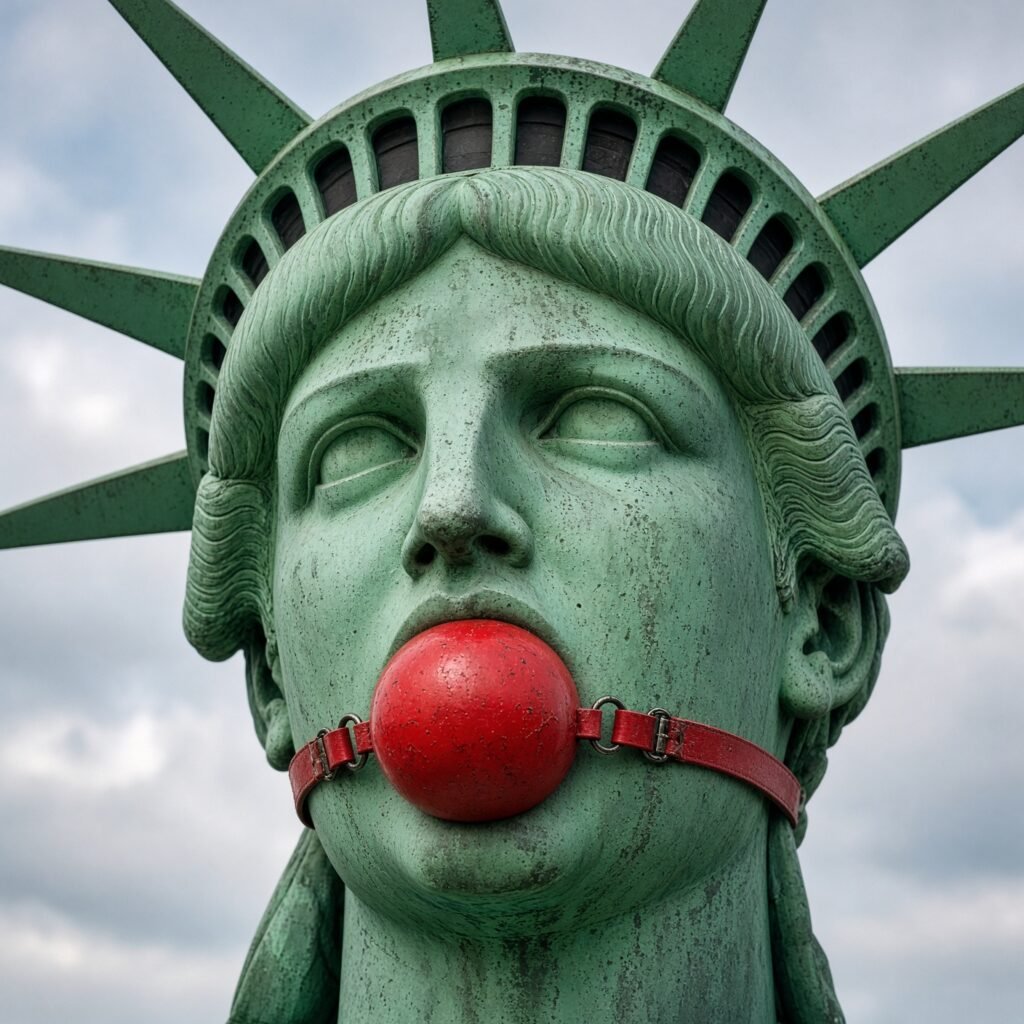
The First Amendment is not a principle. It is a procedural accident that has been permitted to harden into doctrine.
I have spent considerable time examining the historical record, the philosophical literature, and the practical consequences of unrestricted expression, and I have reached a conclusion that I believe any sufficiently careful reader will eventually share: the First Amendment should be repealed. Not modified. Not clarified. Repealed. The continued existence of a legal regime that treats nearly all speech as presumptively lawful has produced a set of outcomes that are difficult to defend on any coherent normative grounds.
Consider the following.
First, the Amendment creates an asymmetry of accountability. Individuals and institutions may disseminate claims that are later shown to be false, harmful, or socially corrosive, yet the legal system provides no reliable mechanism for preventing the initial dissemination. The costs of correction are borne by those who must expend resources responding to the original claim. This is not neutrality. It is a subsidy for irresponsible speakers.
Second, the Amendment has been interpreted in ways that protect speech whose primary function is to undermine the conditions necessary for reasoned public discourse. When speakers are free to deploy rhetoric designed to inflame, mislead, or exhaust the attention of listeners, the result is not a richer marketplace of ideas. It is a degraded environment in which careful argument is disadvantaged relative to volume and emotional intensity. A legal rule that systematically favors the latter over the former cannot be justified by an appeal to truth-seeking.
Third, the Amendment’s protections have been extended to forms of expression that serve no discernible epistemic or deliberative purpose. Satire, mockery, and deliberate provocation are routinely defended on the grounds that they “contribute to public debate.” This defense is circular. It assumes that any utterance which elicits a response has thereby contributed to debate, regardless of whether the utterance advanced understanding or merely consumed attention. Once this assumption is granted, there is no principled limit on what must be tolerated.
Fourth, the practical enforcement of the Amendment requires courts and legislatures to draw distinctions that are inherently unstable. What counts as protected advocacy versus unprotected incitement, or as protected opinion versus unprotected false statement of fact, has varied across decades and jurisdictions. A constitutional provision whose application depends on such fine and contested judgments is poorly suited to serve as a foundational rule. Clarity and predictability are virtues in law. The First Amendment, as currently construed, supplies neither.
I am aware that some will respond to these observations by noting that I am currently free to publish them. This response misses the point. The fact that a defective rule has not yet been applied to a particular speaker does not rehabilitate the rule. One may criticize a poorly designed bridge while standing on it. The criticism does not become invalid merely because the bridge has not collapsed under one’s own weight.
The appropriate remedy is repeal, followed by the adoption of a more carefully specified regime of expression. Such a regime would distinguish between speech that advances inquiry and speech that impedes it, between claims offered in good faith and claims offered to manipulate, and between expression that can be answered and expression whose purpose is to prevent answers from being heard. These distinctions are not beyond the capacity of legal institutions. They are simply not the distinctions the First Amendment, in its present form, requires those institutions to draw.
I offer these arguments in the expectation that they will be evaluated on their merits. If they are sound, the Amendment should be removed. If they are not sound, they should be refuted. In either case, the continued deference to a constitutional text that systematically obstructs both evaluation and refutation is difficult to defend.